How To Plan A Galapagos Itinerary That Actually Works
A Galapagos week has fewer usable days in it than the calendar suggests. Two of them belong to the airport, and every island change costs you another.
Short answer
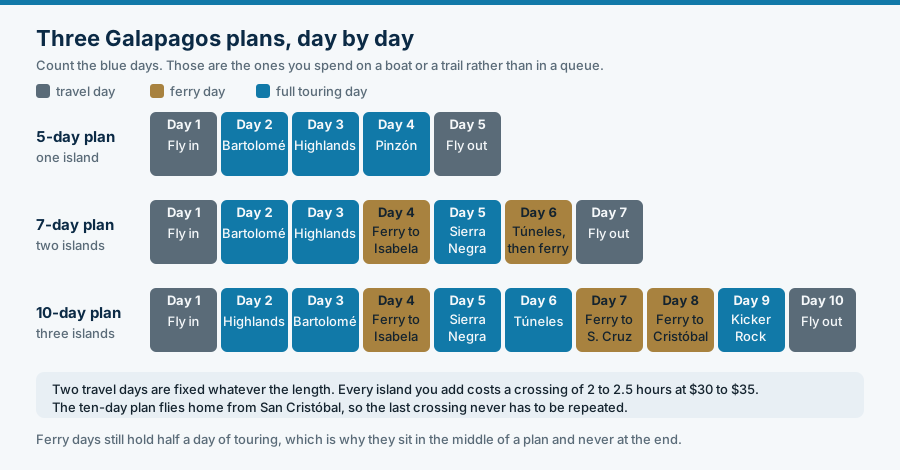
Plan around usable days, not total days. Arrival and departure days are travel days, and each inter-island ferry burns most of another. Five days gives you Santa Cruz plus two boat tours, seven days adds a second island, and ten days lets you reach three islands without rushing.
My 2021 trip was land-based island hopping, and I got the arithmetic wrong. I had booked what I thought was a week in the Galapagos. What I actually had was a landing day that ended at four in the afternoon, two ferry mornings, and a departure day where I sat in a hotel lobby watching other people's boats leave. Three of my seven days were logistics.
That is the whole problem with Galapagos itineraries, and it does not show up in any planning tool. The islands look close together on a map. They are two to two and a half hours apart by small boat, in one direction only, and once a day in each direction. Everything below is built around that constraint rather than around wishful thinking.
How Many Usable Days Does A Galapagos Trip Really Have?
Subtract two days from your total before you plan anything. The arrival day ends after transfers, and the departure day is gone entirely because flights leave in the morning. Then subtract most of a day for every inter-island ferry. A seven-night trip with one island change gives you roughly four full touring days.
The Baltra arrival is the worst offender. You land, queue for the park fee, collect bags, ride a shuttle to the Itabaca Channel, cross on a small ferry, then travel south across Santa Cruz to Puerto Ayora. San Cristóbal is kinder, with a short taxi ride into town, but the flight still eats the morning.
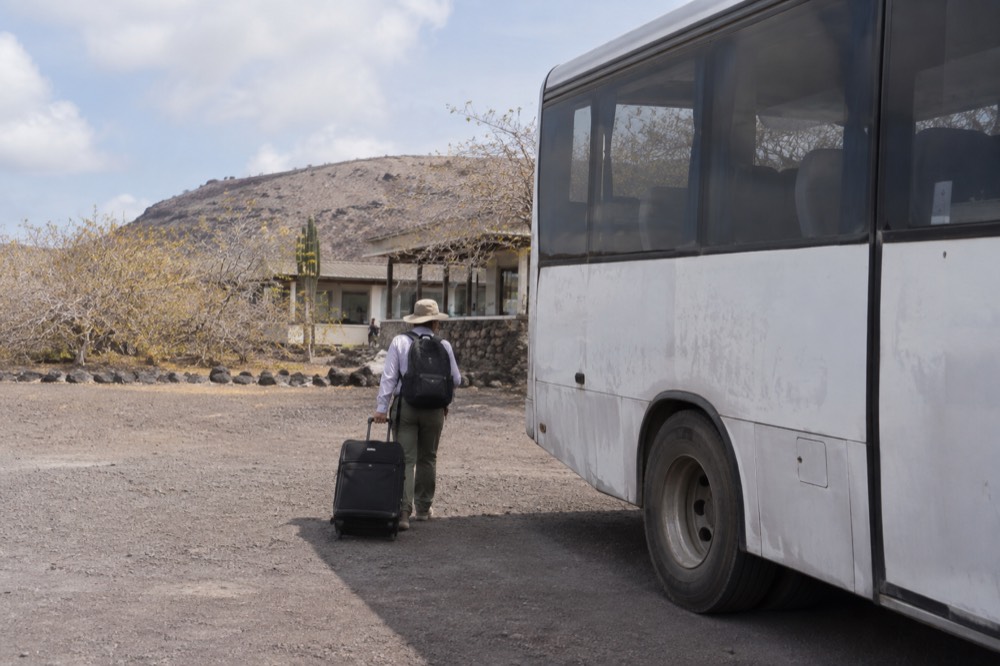
Departure is stricter. Island flights back to the mainland leave in the morning, and from Puerto Ayora you need to start the reverse Baltra journey around two hours before check-in. There is no day tour short enough to fit. People try to book a half-day bay trip on their last morning and either miss the flight or spend the whole excursion looking at their watch. Do not do it.
| Trip length | Travel days | Ferry days | Full touring days |
|---|---|---|---|
| 4 nights, one island | 2 | 0 | 2 to 3 |
| 5 nights, one island | 2 | 0 | 3 to 4 |
| 7 nights, two islands | 2 | 1 | 4 |
| 10 nights, three islands | 2 | 2 | 6 |
| 10 nights, two islands | 2 | 1 | 7 |
That last row is the one experienced travellers pick. Fewer islands, more days on each, less time in a boat with your luggage. If you are still choosing a trip length, how many days you need works through the trade in more detail.
The airport you choose changes how big the hole in day one turns out to be. Only two airlines fly the route, Avianca and LATAM, from Quito or Guayaquil to either Baltra or San Cristóbal, with the flight running roughly two hours from Guayaquil and about three from Quito including the stop. A Baltra landing costs you the afternoon to the channel crossing and the drive south. A San Cristóbal landing puts you in town within minutes of the airport, which is why serious planners fly into one island and out of the other whenever the fares allow it.
If even five days is more than your calendar can hold, a short structured trip beats a doomed one. One product we track is the 3-Day Galapagos Trip for Traveler Without Much Time, a group itinerary from $5600 per group that includes the hotel, breakfast and lunch, transfers, a boat-based snorkelling day and a tour leader who doubles as photographer, with free cancellation on the listing. It has no rating yet, so there is no review record to judge it by, but it is one of the few options designed for people who genuinely have only 72 hours. The arithmetic does not lie even at this length: day one and day three are travel days by definition.
What Does A Good 5-Day Galapagos Itinerary Look Like?
Stay on Santa Cruz the whole time. It has the widest tour choice, the best ferry connections and the shortest transfer to the tortoise highlands. Five days gives you two full boat tours, one half day, and the free afternoons that make the islands enjoyable rather than exhausting.
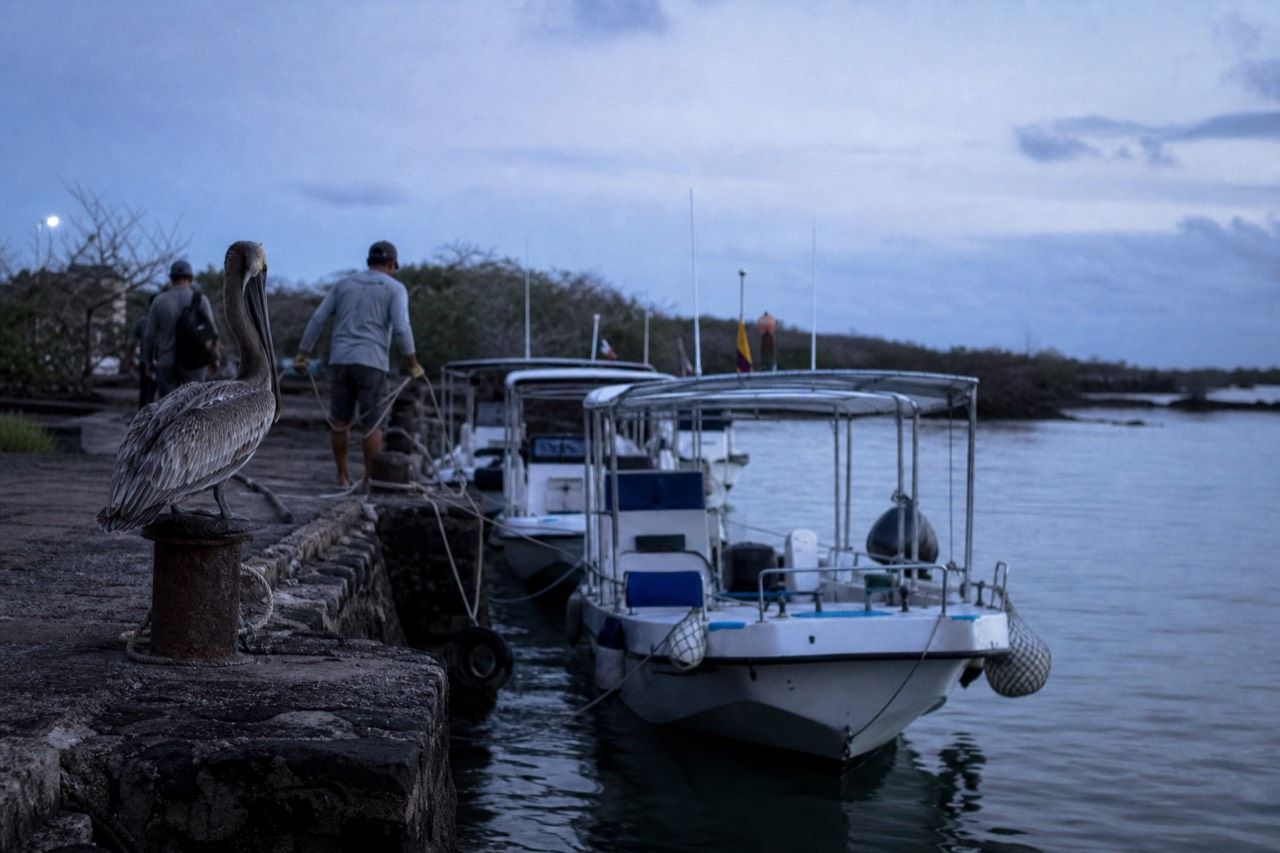
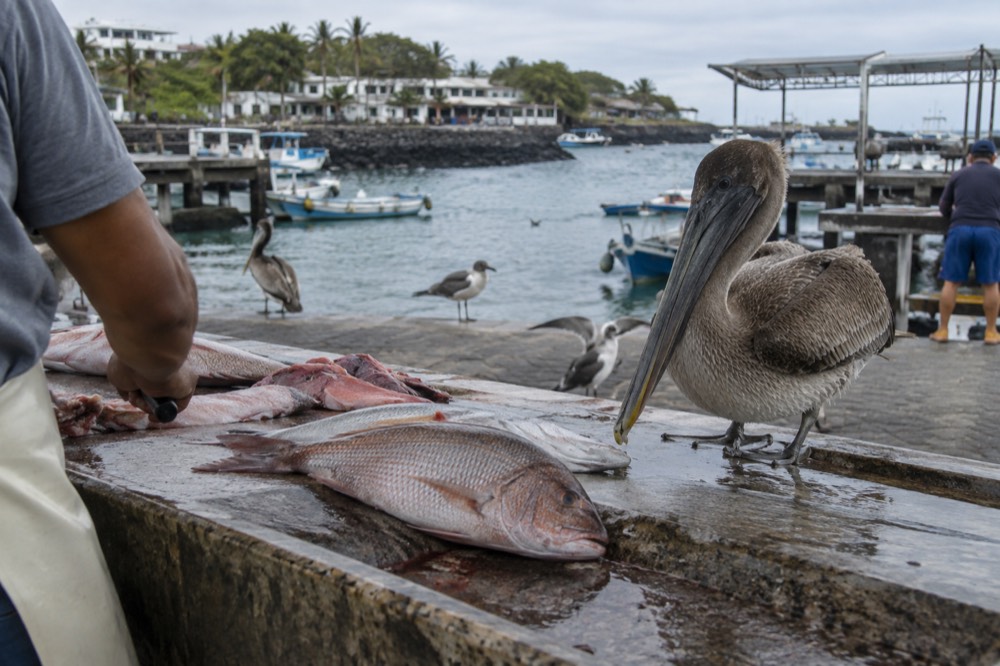
Santa Cruz is the hub for a reason. Almost every day-tour operator in the archipelago sails from Puerto Ayora, and the town has the restaurants, the fish market with its queue of pelicans, and the trail out to Tortuga Bay.
| Day | Plan | Roughly |
|---|---|---|
| 1 | Fly in to Baltra, transfer to Puerto Ayora, Charles Darwin Station in the late afternoon | Half day |
| 2 | Bartolome Island full-day tour | 10 hours |
| 3 | Giant tortoise highlands and lava tunnels in the morning, Tortuga Bay walk after lunch | 3 hours plus |
| 4 | Pinzón Island day tour, snorkelling and a beach stop | 7 hours |
| 5 | Fly home from Baltra | Travel day |
Day 2 is deliberately the big one. If a swell cancels a boat, and it happens, you still have days 3 and 4 to reschedule into. Putting your must-do tour on the final touring day removes that cushion.
The Bartolome Island full day tour is the trip most people build the week around: the pinnacle rock viewpoint, a lunar landscape of spatter cones, and snorkelling where penguins occasionally show up. It runs about ten hours door to door. Read the itinerary and Check availability, because seats on the good boats go early in high season. The rest of what leaves from Puerto Ayora is on the Santa Cruz day tours page.
Day 3 is the cheapest and most underrated day of the plan. The Santa Cruz highlands are where you see giant tortoises living free rather than behind fences, and the lava tunnels nearby fit into the same half day. The archipelago-wide population across all islands now stands at roughly 20,000 to 25,000 animals, and the highland reserves on Santa Cruz are the easiest place in the Galapagos to encounter them on their own terms.
To cover it, the Giant Tortoise Watching and Lava Tunnels Tour from Galápagos frontier is a private, three-hour excursion on Santa Cruz from $39.99 per person, with coffee or tea included and free cancellation on the listing. It carries a 4.8 rating from 80 reviews, and because it is short and private it slots into the same day as the afternoon Tortuga Bay walk without any strain, which is exactly what the itinerary above asks of it.
Day 4, the Pinzón boat, comes with a conservation story the itinerary line does not carry. Black rats suppressed the island's tortoise hatchlings for more than a century until an eradication campaign succeeded in 2012, and more than 1,000 juvenile tortoises have since been repatriated. The tour itself is a seven-hour trip out of Puerto Ayora combining snorkelling and fishing around Pinzón and La Fé or Palmitas Bay, from $249 per person with wetsuits, snorkel gear and towels included. It carries a 4.9 rating from 154 reviews, the deepest feedback record of any day boat we list, which makes it a sensible default for your first full snorkelling day.
What Does A 7-Day Itinerary Add?
A second island, usually Isabela. Seven nights absorbs one ferry crossing without wrecking the trip, and Isabela gives you a live volcano rim, flamingo lagoons and the best shallow snorkelling in the archipelago. It also has the cheapest day tours of any island.
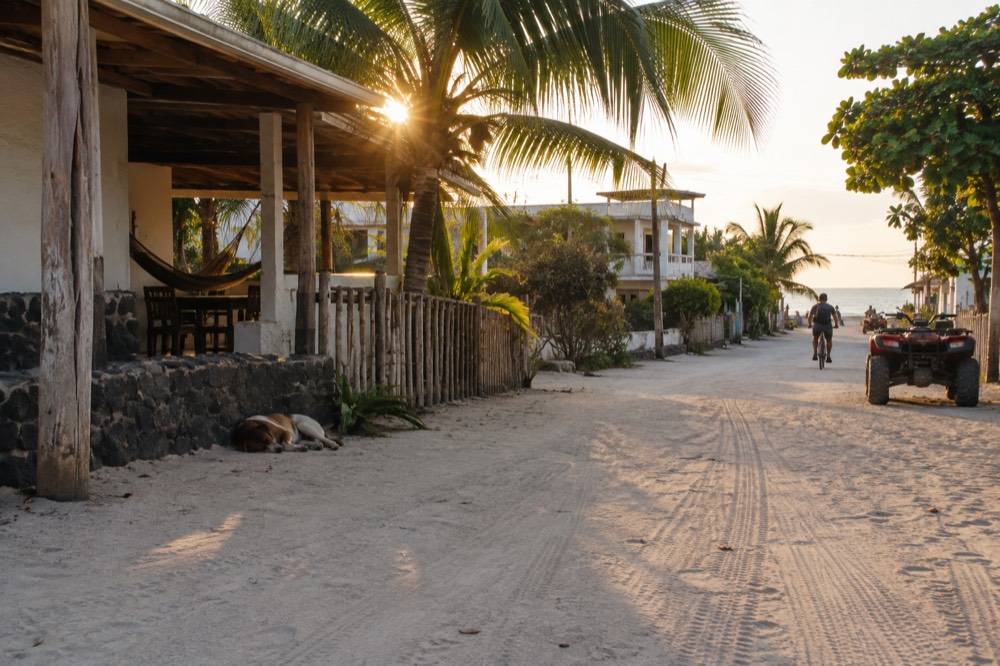
Isabela is the largest island and the slowest. Puerto Villamil is a sand-street town where nothing is urgent, which is exactly why people who go there wish they had given it more nights.
| Day | Plan | Base |
|---|---|---|
| 1 | Arrive Baltra, transfer, settle in Puerto Ayora | Santa Cruz |
| 2 | Bartolome Island full-day tour | Santa Cruz |
| 3 | Highlands tortoises and lava tunnels, afternoon at Tortuga Bay | Santa Cruz |
| 4 | Morning lancha to Isabela, afternoon at the Tintoreras or the wetlands | Isabela |
| 5 | Sierra Negra volcano hike | Isabela |
| 6 | Cabo Rosa tunnels snorkelling, afternoon lancha back to Santa Cruz | Both |
| 7 | Fly home from Baltra | Travel day |
Day 6 is tight but workable, because the tunnels trip runs about five hours and afternoon lanchas leave Puerto Villamil in the mid-afternoon. If that makes you nervous, move the snorkelling to day 5 and hike the volcano on day 4, or add a night.
The Sierra Negra hike is the outlier in Galapagos pricing. Day tours from Isabela run roughly $75 to $187 against $145 to $245 from Santa Cruz, and the volcano sits at the bottom of that band because it is a land excursion with no boat costs attached. If budget is shaping your plan, our cost breakdown has the full price picture by island.
The plan above moves you to Isabela for two nights, which is what I would tell most seven-night travellers to do. The alternative is to stay on Santa Cruz the whole week and take Isabela as a day trip: a boat leaves Puerto Ayora in the morning, crosses the channel, and comes back the same evening. You give up the slow evenings in Puerto Villamil, but you keep one hotel room, one unpacking and zero ferry mornings with your luggage.
The day tour that does this, run by Guiding Galapagos Expeditions, covers the Tintoreras islet, a snorkelling session, the wetlands and the flamingo lagoons in a single loop, and the details are on the Isabela island tours page. It runs about ten hours from Puerto Ayora, costs from $285 per person, and includes wetsuits in your choice of length, snorkel gear, lunch, soft drinks, the fuel surcharge and even the pier fee charged in Puerto Ayora. The listing shows a 4.7 rating from 138 reviews, and you can Check availability for current dates.
It is a long day, and it is not a substitute for actually staying on Isabela. What it buys instead is simplicity: no hotel change, no ferry booking to make, and a flamingo lagoon in the middle of what would otherwise be an ordinary Tuesday on Santa Cruz.
What Can You Do With 10 Days?
Reach three islands properly, or two islands slowly. Ten nights is the first length where San Cristóbal earns its place alongside Santa Cruz and Isabela, and where you can absorb a weather cancellation without losing a headline tour. Fly into Baltra and out of San Cristóbal to avoid a backtracking ferry.
There is no direct boat between Isabela and San Cristóbal. Every route between them passes through Santa Cruz, which is why the order below runs west to east rather than jumping around.
| Day | Plan | Base |
|---|---|---|
| 1 | Arrive Baltra, transfer to Puerto Ayora | Santa Cruz |
| 2 | Santa Cruz highlands, lava tunnels, Charles Darwin Station | Santa Cruz |
| 3 | Bartolome Island full-day tour | Santa Cruz |
| 4 | Morning lancha to Isabela, afternoon Tintoreras or Concha de Perla | Isabela |
| 5 | Sierra Negra volcano hike | Isabela |
| 6 | Cabo Rosa tunnels snorkelling | Isabela |
| 7 | Lancha to Santa Cruz, half-day bay tour or Tortuga Bay in the afternoon | Santa Cruz |
| 8 | Lancha to San Cristóbal, afternoon at La Lobería | San Cristóbal |
| 9 | Kicker Rock full-day snorkelling tour | San Cristóbal |
| 10 | Fly home from San Cristóbal | Travel day |
Two ferry days in ten is the acceptable ceiling. Three is where the trip starts to feel like commuting.
If you would rather trade the third island for depth, drop days 8 and 9 and give Santa Cruz a Santa Fe or Pinzón boat instead. Which island to base yourself on works through what each one actually offers.
Depth, in practice, means more boat days out of Puerto Ayora, and the two best candidates are Santa Fe and Pinzón. Santa Fe is the shorter and gentler of the two. Where Bartolomé is a long run out to a stark volcanic landscape, Santa Fe is a compact island with a calm anchorage, and the day divides between snorkelling from the boat and time on Hidden Beach rather than a demanding hike.
The Santa Fe day tour, also from Guiding Galapagos Expeditions, is a seven-hour trip from Puerto Ayora with snorkelling and fishing, from $229 per person, including snorkel gear, lunch, coffee or tea, bottled water and soft drinks. It carries a 4.9 rating from 91 reviews. Pair it with Pinzón on consecutive days and you get two full marine days without the ten-hour length of the Bartolomé run.
How Do Ferry Days Constrain The Plan?
Lanchas run Santa Cruz to Isabela and Santa Cruz to San Cristóbal, typically once in the morning and once in the afternoon, at about $30 to $35 and two to two and a half hours per crossing. Any island change costs you either a morning or an afternoon, and there is no direct Isabela to San Cristóbal service.
Three practical rules come out of that. Move islands on a morning boat so the afternoon is still yours. Never plan a tour that ends less than two hours before a ferry departure. And treat Santa Cruz as the pivot, because every route runs through it whether you want it to or not.
Weather is the other constraint nobody plans for. The crossings are open ocean, and in the garúa season from June to November the channels get lumpy. Boats rarely cancel outright, but a rough crossing followed by a ten-hour tour the same day is a miserable combination.
Two practical notes on the crossings themselves. The fare, $30 to $35 per person each way, is paid locally at the agencies around the port rather than online, and in busy weeks it pays to buy the morning boat the day before rather than on the morning itself. In the garúa season the sea sits at 66 to 72 degrees Fahrenheit against 74 to 76 in the warm months, and if you are prone to seasickness that difference across two and a half hours of open channel is worth packing tablets for.
Keep your ferry luggage small regardless of season. The lanchas are small boats with limited dry storage, and a soft duffel you can hold on your lap beats a rigid suitcase every time. Anything you cannot afford to get wet, camera gear, passports, medication, goes in a dry bag inside it.
When Should You Book Each Tour?
Book the one tour you most want before you fly, especially Bartolome and Kicker Rock, and especially in June to August and December to January. Leave one or two slots open to book in town, where agencies sell remaining seats and you can react to weather. Never leave the headline tour to chance.
Boat capacity in the Galapagos is capped by the park, and the good operators sail small groups. That is the entire reason the popular days sell out while the town still looks quiet. The Galapagos Conservancy's trip planning pages make the same point about permits and site quotas from the conservation side.
Booking in town is not the bargain it once was. It works for filling gaps, less so for building an itinerary, and it puts you at the mercy of whatever has seats on the morning you ask.
One more scheduling note. All visits to protected sites happen with a park-authorised naturalist guide, and the park's visitor rules also set the 2 metre wildlife distance that applies everywhere. Tours are built to those rules, which is why itineraries look similar across operators and why the difference between boats is comfort, group size and lunch rather than access.
When you do book, compare the inclusions before the price. Wetsuits, towels, snorkel gear, lunch, hotel pickup and pier fees are all included on some listings and rented or charged separately on others, and the difference over a full week is real money. Two boats at the same headline price are rarely the same deal once you read what is actually in them.
North Seymour is the other headline boat worth booking well ahead. The North Seymour Day Trip from Galapagos Tours Nature Galapagos & Ecuador runs nine hours from Santa Cruz Island with hotel pickup, a bilingual professional guide, towels and lunch, from $360. The listing shows a 5 from 3 reviews, which is too small a sample to mean much on its own; the reason to book early is the island itself, one of the dependable sites within day range of Santa Cruz for boobies and frigatebirds, not the score.
Because the park caps group sizes and every visitor to a protected site must be with a GNPD-authorised naturalist guide, the number of seats on any given day is genuinely fixed. That is the whole logic of booking the headline tour first and leaving the filler days flexible.
How Much Should You Budget Beyond The Tour Prices?
The fixed costs outside the tours are the ones people forget: $200 per foreign adult for the park entrance fee, $20 for the Transit Control Card, and domestic flights that commonly run $285 to $600 round trip. Work them out before you choose hotels, because they are identical whether you stay four nights or ten.
The park fee is paid on arrival, to the rangers at the counters at Baltra and San Cristóbal airports. Foreign adults over 12 pay $200 and children under 12 pay $100, after the adult fee was doubled from $100 effective August 1, 2024, so any budget template written before that date understates it. Card payment at the airport counter is not confirmed, so plan on cash.
The Transit Control Card is separate and happens earlier. It costs $20 per person and is pre-registered and paid online through the official CGREG system before you fly, then presented at the mainland airport. Miss it and you miss the plane.
The flights themselves leave you little choice, since Avianca and LATAM are the only two airlines operating from Quito and Guayaquil to Baltra and San Cristóbal, roughly two hours from Guayaquil and about three from Quito including the stop. Round-trip fares commonly range from $285 to $600 depending on dates. Baggage is one checked bag up to 23 kg plus a carry-on of 8 to 10 kg, and every bag, carry-ons included, goes through the mandatory SICGAL biosecurity inspection before check-in.
| Fixed cost | Amount | When you pay it |
|---|---|---|
| Park entrance fee | $200 per foreign adult, $100 per child under 12 | At the airport on arrival |
| Transit Control Card | $20 per person | Online, before you fly |
| Domestic flights | $285 to $600 round trip | When you book |
| Inter-island ferry | $30 to $35 per crossing | Locally, before boarding |
| Hotels | $30 to $65 budget, $65 to $150 mid-range, per night | As you book |
None of that is negotiable, which is the point. It is the floor under the trip, and it is the same floor whether your touring days number two or seven.
Which Season Fits The Wildlife You Want To See?
There is no bad month, only a trade: the warm season from December to May brings calmer seas and water of 74 to 76 degrees Fahrenheit, while the cooler garúa season from June to November brings greyer skies, water of 66 to 72 degrees, and the richest feeding activity. Choose by the single animal you would be saddest to miss.
| Wildlife | Timing | Notes |
|---|---|---|
| Blue-footed boobies | Courtship and mating June to August | The courtship dance comes first |
| Waved albatross on Española | April to December, absent January to March | Eggs laid April to June |
| Giant tortoise breeding | January to May | Nesting follows; eggs hatch after roughly 130 days |
| Sea lion pups | Pupping peaks August and September | Breeding season July to December, varying by island |
| Galapagos penguins | Year-round, nesting possible May to December | No clearly defined season |
| Whale sharks at Darwin and Wolf | June to November | Cruise-only sites, no day tour reaches them |
The water temperature is the number that should drive your packing more than any wildlife calendar. Seventy-four degrees sounds balmy until you have been floating in it for an hour, and 66 sounds unswimmable until you are wearing a wetsuit. Some listings include wetsuits, the Pinzón and Isabela day tours among them, in short or long versions, which removes the rental question before you even leave home.
Two entries in that table deserve a planning note. The waved albatross are the strictest deadline in the archipelago, because they are simply absent from Española between January and March, and no amount of flexible booking fixes a wrong month. The giant tortoise calendar is more forgiving on paper, since breeding runs January to May, but the highland reserves on Santa Cruz hold resident animals you can see in any month of the year.
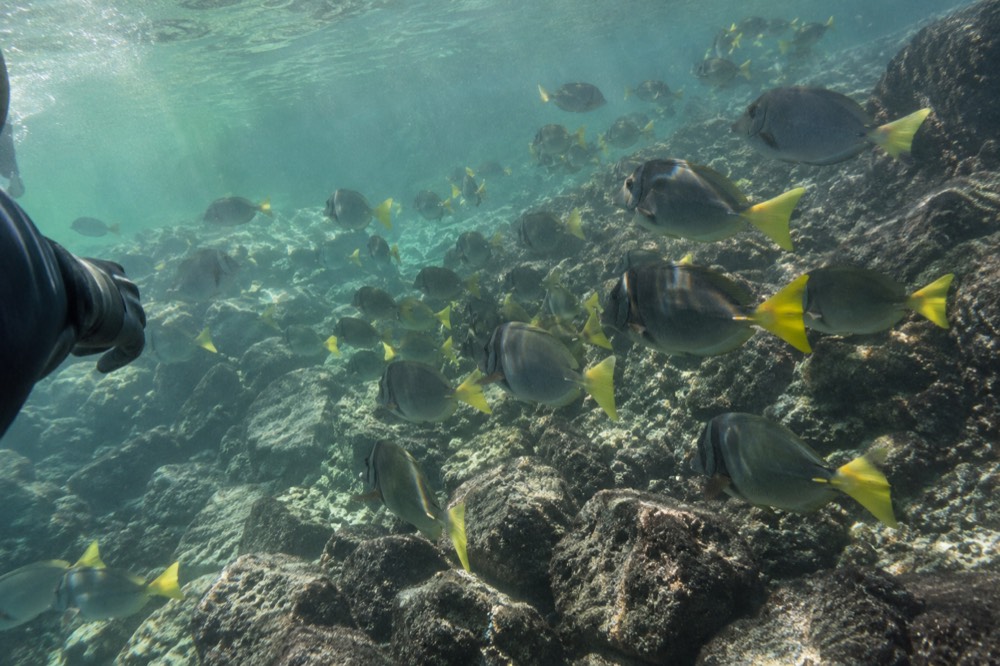
One thing that is true in every month: all of this happens inside protected water. The Hermandad Marine Reserve, created in January 2022, added 60,000 square kilometres to the existing Galápagos Marine Reserve and brought the total protected marine area to 198,000 square kilometres. The fish density you snorkel through on a day tour is a direct product of that protection.
What Should You Pack For A Day Tour?
Pack around the boat, not the island: sun protection, a dry change of clothes, motion-sickness tablets and a wetsuit decision cover most of what makes a day tour comfortable. Almost everything else can be bought in Puerto Ayora, at island prices.
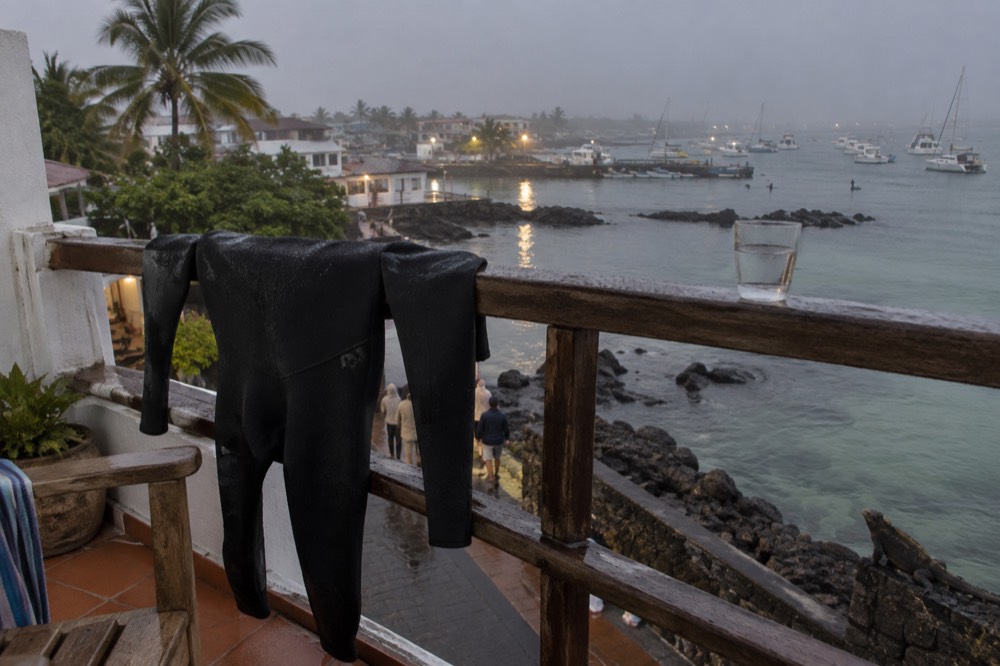
The wetsuit decision is the one I have had to make on all three of my trips, and the month decided it more than anything else. In the warm season a shorty is enough for most people on a single snorkelling stop. In the garúa months, from June to November, a long suit is the difference between staying in the water for twenty minutes and staying for an hour, and anyone who runs cold should treat it as non-negotiable.
Biosecurity shapes the bag as much as the sea does. Drones are not permitted in the Galápagos National Park or Marine Reserve, so leave them at home regardless of the footage you were imagining. Fresh fruits, vegetables, seeds, plants and many animal products are regulated or prohibited for entry, and the official ABG list, updated by Resolución N° D-ABG-065-11-2023, is the reference to check before you pack snacks. The SICGAL inspection at Quito or Guayaquil screens every bag including carry-ons, so do not assume a forgotten apple will slip through.
The rest of the kit is unglamorous. A dry bag for electronics, a hat that will survive wind, a warm layer for the boat ride back, and more sunscreen than seems reasonable, because the equatorial sun reflects off the water from below as well as above.
How Do You Choose Between Two Similar Day Tours?
Read the inclusions, then the duration, then the review depth, in that order. The headline price hides most of the differences between boats, and a $249 tour that includes wetsuits, towels and lunch costs less on the day than a cheaper one that rents all three at the pier.
Typical day tours from Santa Cruz run $145 to $245 per person, so two of the four boats in the table below sit above the usual band, and Bartolomé sits furthest above it. You are paying for the longest navigation and the single most photographed view in the archipelago, plus hotel pickup, a bilingual guide, snacks, lunch and all taxes and fees on the listing.
| Tour | Length | Price from | Rating | Reviews |
|---|---|---|---|---|
| Bartolomé Island full day | 10 hours | $378 per person | 4.8 | 21 |
| Isabela, Tintoreras and flamingos | 10 hours | $285 per person | 4.7 | 138 |
| Pinzón snorkel and fishing | 7 hours | $249 per person | 4.9 | 154 |
| Santa Fe snorkel and fishing | 7 hours | $229 per person | 4.9 | 91 |
Review counts matter as much as the score. A 5 from 3 reviews, like the North Seymour trip, is a perfect record with almost no evidence in it. The Pinzón tour's 4.9 from 154 reviews is the deepest set of customer feedback on any day boat we list, and Santa Fe's 4.9 from 91 is not far behind. Bartolomé's 4.8 from 21 reviews is strong but thin, which is normal for a tour at that price point and does not change the fact that the site sells itself.
Duration is the quiet third factor, because it decides what kind of day you are actually buying. The two seven-hour boats leave room for a slow dinner and an evening walk afterwards. The two ten-hour boats are the whole day, door to door, and pairing them back to back is how people end their holiday more tired than they started it. Spread the long ones out, sandwich them with the highlands and the beaches, and the week balances itself.
Once you know which shape of day suits you, the full day trip list is where to compare everything else that leaves from Puerto Ayora, and the island hopping guide covers the multi-island version of the same decision. Whichever route you take, the plan holds together only if the travel days, ferry days and booking order were decided before the fun parts were.