How Many Days Do You Need In The Galapagos?
Count the days you can actually put on a boat, not the nights on your booking confirmation. They are rarely the same number.
Short answer
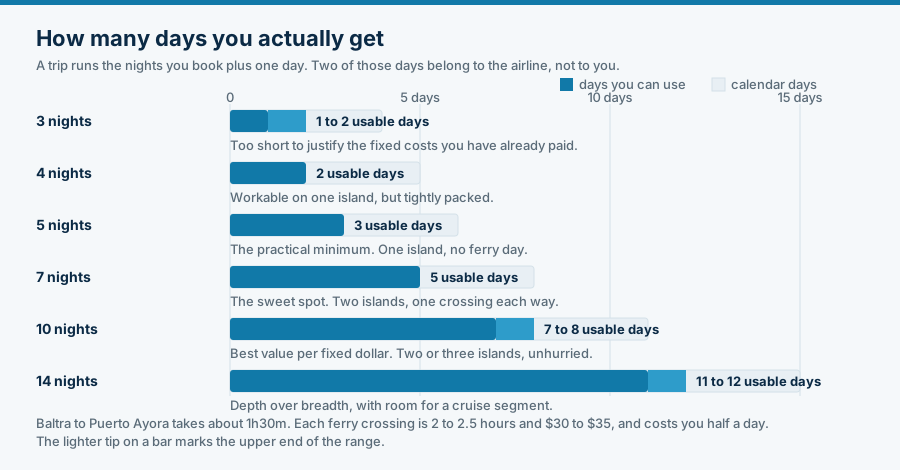
Five nights is the practical minimum and seven is the sweet spot. Your arrival and departure days are half-days at best, so a five-night trip yields about three full excursion days and a seven-night trip yields five. Add a day for every inter-island ferry, since each crossing takes 2 to 2.5 hours and usually kills a morning or an afternoon.
My flight out of Guayaquil left early, and before I could even check a bag I had to queue at the biosecurity desk to have it inspected and sealed. Then a two-hour flight, then a bus, then a ferry crossing the Itabaca Channel, then a taxi down to Puerto Ayora. By the time I dropped my bag at the hotel, the day was gone. That is the part nobody puts in an itinerary, and it is the reason most Galapagos trips are one day shorter than they look on paper.
How Many Days Do You Actually Need In The Galapagos?
Five nights is the realistic minimum and seven is where the trip stops feeling rushed. Because arrival and departure days are consumed by flights, formalities and transfers, a five-night trip delivers roughly three usable excursion days, and a seven-night trip delivers five. Ten nights lets you cover two or three islands properly.
The arithmetic is simple once you accept the half-day rule. Whatever number of nights you book, subtract one day for arrival and most of another for departure. Then subtract half a day for every ferry crossing between islands. Whatever remains is your real supply of boat days, and boat days are what you flew here for.
That is also why very short trips disappoint people. Three nights sounds like a reasonable add-on to a mainland Ecuador holiday, and it buys you exactly one proper excursion after you have paid the $200 park fee and the $20 transit card to get through the door. The fixed costs do not shrink with the trip, which is laid out in full in the Galapagos cost breakdown.
| Nights booked | Usable full excursion days | Islands you can cover | Honest verdict |
|---|---|---|---|
| 3 | 1 to 2 | One | Too short to justify the fixed costs |
| 4 | 2 | One | Workable, but tightly packed |
| 5 | 3 | One, or two with one ferry | The practical minimum |
| 7 | 5 | Two comfortably | The sweet spot for most visitors |
| 10 | 7 to 8 | Two or three, unhurried | Best value per fixed dollar spent |
| 14 | 11 to 12 | Three plus a cruise segment | Only if you want depth over breadth |
One thing worth knowing before you count nights is how lopsided the format split is. Of the 290,404 visitors to Galapagos protected areas in 2025, 79% stayed land-based and 21% travelled aboard a cruise. Most people, in other words, are solving exactly the puzzle in this article: how to build a trip from a hotel base and a sequence of scheduled day tours. Total visitor numbers also rose 4% that year over the roughly 279,000 recorded the year before, so the boats and ferries are not getting emptier.
The day count matters more for land-based travellers than it first appears, because every excursion is a discrete purchase with a fixed departure time. A cruise moves while you sleep. A hotel does not. If your week contains only five usable days and two of them go to logistics, you have bought yourself three wildlife experiences, and no amount of clever planning changes that after the flights are booked.
Why Do Arrival And Departure Days Not Count As Full Days?
Arrival involves a mainland biosecurity inspection, a two to three hour flight, the park fee queue, a bus, a channel ferry and a road transfer. Departure requires you back at the airport hours before a mid-morning flight. Neither day supports a full-day excursion, and most operators will not sell you one on either.
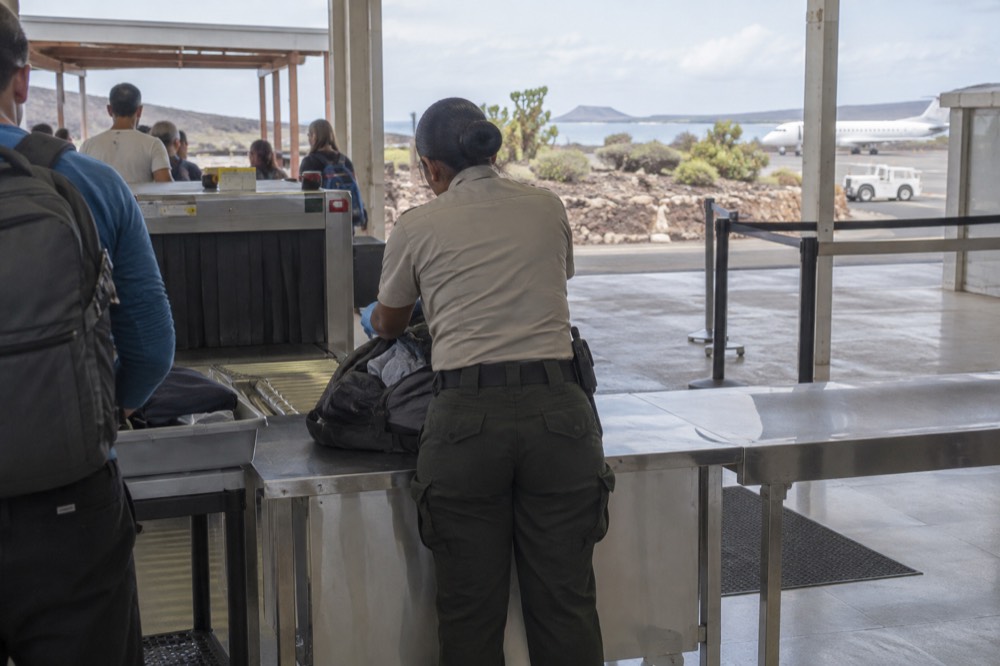
The mainland end of it starts before you board. Ecuador runs a mandatory SICGAL and Agrocalidad baggage inspection at Quito and Guayaquil before check-in, and the list of restricted items covers fresh fruit, vegetables, seeds, plants and many animal products. Get to the airport early, because the queue is real and it is not optional.
Landing at Baltra adds its own sequence. Rangers collect the $200 park entrance fee in cash, then you take a shuttle bus to the Itabaca Channel, cross by ferry, and ride roughly forty-five minutes down the island to Puerto Ayora. San Cristóbal is far kinder: the airport is a short taxi ride from town.
| Stage of arrival day | Typical time cost |
|---|---|
| Biosecurity inspection at UIO or GYE, plus early check-in | 1 to 2 hours before departure |
| Flight, Guayaquil to the islands | About 1h55m to 2h |
| Flight, Quito to the islands via Guayaquil | About 3 hours total |
| Park fee and transit card processing on arrival | 20 to 45 minutes, longer on busy days |
| Baltra to Puerto Ayora, bus plus channel ferry plus road | About 1h30m |
| San Cristóbal airport to Puerto Baquerizo Moreno | About 10 minutes |
Departure day is shorter but no less destructive. Island flights to the mainland tend to leave in the morning, which means a dawn transfer back across the channel from Puerto Ayora. Book a day tour on that morning and you will miss the plane.
Baggage limits shape the packing end of both days. Galapagos flights allow one checked bag up to 23 kg and a carry-on of 8 to 10 kg, and both pieces go through the SICGAL inspection, so packing light is not style advice here, it is queue management. Only two airlines fly the route: Avianca and LATAM, from Quito and Guayaquil to Baltra and San Cristóbal. There is no third option to shop around.
Two cost details belong in the budget early rather than as a surprise. Fares from Guayaquil or Quito start around $150 one way, with round trips commonly landing between $285 and $600 depending on dates and carrier. And the park fee, raised from $100 to $200 for foreign adults in August 2024, is $100 for children under 12, while the $20 transit card is bought online through the official CGREG system before you fly rather than at the airport.
How Much Time Do Inter-Island Ferries Really Cost?
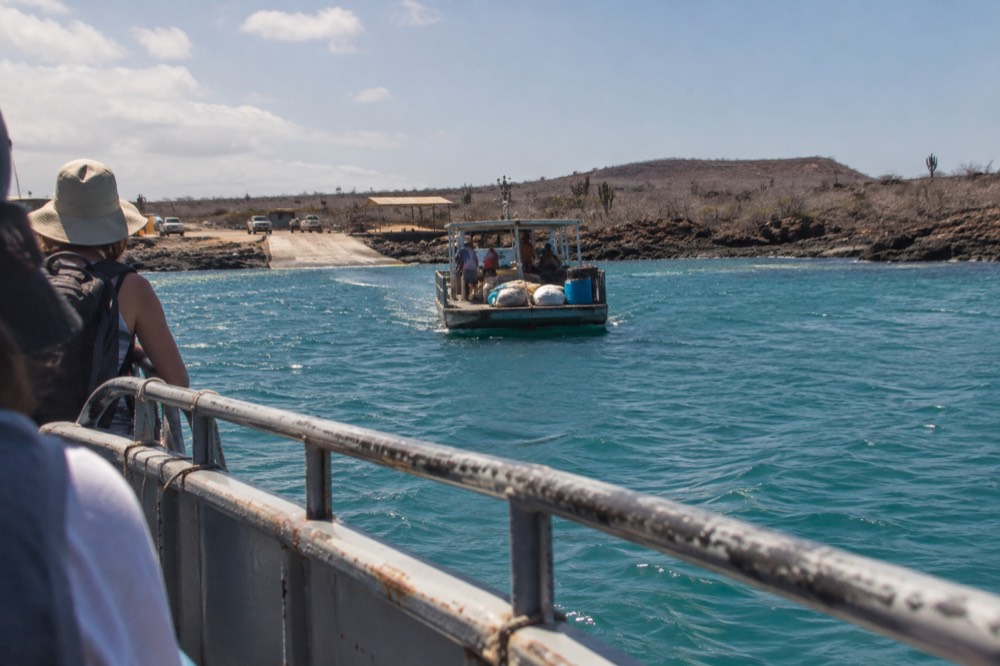
Each lancha crossing takes 2 to 2.5 hours and costs $30 to $35, but the real cost is the half-day it consumes. Boats run on fixed morning and afternoon departures, and there is no direct Isabela to San Cristóbal service, so that pairing costs you two crossings through Santa Cruz.
The two and a half hours in the boat is only part of it. You need to be at the dock ahead of departure, take a water taxi out to the lancha, then a water taxi back in at the far end, and then find your hotel. Rough water in the cool season stretches the crossing further. Plan a ferry morning as a ferry morning and nothing else.
| Route | Crossing time | One-way fare | Practical time lost |
|---|---|---|---|
| Santa Cruz to Isabela | 2 to 2.5 hours | $30 to $35 | Half a day |
| Santa Cruz to San Cristóbal | 2 to 2.5 hours | $30 to $35 | Half a day |
| Isabela to San Cristóbal | No direct service | $60 to $70 via Santa Cruz | A full day |
This is why two islands in five nights is possible but three is not. If you are weighing which pair to combine, the island base comparison sets out what each town gives you and which day tours leave from where.
The ferry timetable also quietly caps your tour options. Day boats out of Puerto Ayora leave in the morning, and so do the lanchas, so a crossing day cannot double as a boat-tour day however neatly the calendar is arranged. Travellers who try it anyway end up watching their tour depart without them from the wrong dock.
And the half-day rule compounds faster than people expect. Two islands means one crossing; three means two, and because there is no direct Isabela to San Cristóbal service, that second crossing routes through Santa Cruz and eats a full day on its own. Add hotel check-ins, dock waiting and the packing in between, and a three-island week quietly loses close to two of its seven days. That is the quiet arithmetic behind the advice further down: two islands done properly beat three done thinly.
What Does A Five-Day Trip Look Like In Practice?
Five nights on one island gives you three excursion days: one big boat day, one land day in the highlands, and one flexible day for a beach, a shorter tour or bad weather. Basing on Santa Cruz makes this the strongest short trip, because it has the widest day-tour choice.
Here is the shape I would give a friend with five nights and no wish to spend them on ferries. Arrive at Baltra, base in Puerto Ayora, and never pack a bag again until you leave.
Day one is arrival and a walk into town. Day two is your marquee boat day, ideally out to a snorkelling island. Day three goes to the highlands: giant tortoises in the wild, a lava tunnel, a crater. Day four is the second boat day or a rest day at Tortuga Bay depending on how you feel. Day five is departure.
For that marquee day, the Santa Fe Island and Hidden Beach tour is the one I would point at first. Seven hours, snorkelling, fishing, endemic land iguanas and a beach most visitors never see, and you can Check availability for your dates. It rates 4.9 across its reviews, though the review count on these island listings is modest because most Galapagos travel is still booked direct rather than through the big platforms. The full set of Santa Cruz day tours covers the shorter three-hour options for your flexible day.
The highlands day deserves a specific budget note, because it is the cheapest big experience on Santa Cruz. The Giant Turtle Watching and Lava Tunnels Tour run by Galápagos frontier lasts three hours, is priced from $39.99 per person, and is a private outing. The listing shows 4.8 from 80 reviews, free cancellation, and coffee or tea included, which makes it an easy fit for the flexible day as well as the scheduled one.
The numbers behind that morning are worth knowing. An estimated 20,000 to 25,000 giant tortoises live across the islands, and the Santa Cruz highlands are among the most reliable places to see them in the wild rather than behind a fence. Three hours covers the reserves, a walkable lava tunnel and a crater rim, and you are back in Puerto Ayora by early afternoon with the lowlands still in front of you.
If day four becomes a second boat day instead of a beach day, the classic upgrade is Bartolomé. The Bartolomé Island Full Day Tour from Santa Cruz runs ten hours with hotel pickup, a bilingual professional guide, lunch, snacks and all taxes and fees handled, and the listing shows 4.8 from 21 reviews, from $378 per person. Typical Santa Cruz boat days run $145 to $245, so this sits at the premium end of the local range, and the viewpoint and the snorkelling around Pinnacle Rock are what people are paying for.
What Does Seven Days Unlock That Five Does Not?
Seven nights buys you a second island. The standard shape is four nights on Santa Cruz and three on Isabela, with one ferry between them, giving five excursion days across two very different landscapes: highlands and snorkelling on one, volcano and lava tunnels on the other.
The step from five to seven is the biggest single jump in trip quality, because it moves you from one island to two without turning the week into transit. Santa Cruz has the tortoise highlands, the Darwin Station and the widest boat choice. Isabela has the volcano, the penguins, the flamingo lagoons and the cheapest excursions in the archipelago.
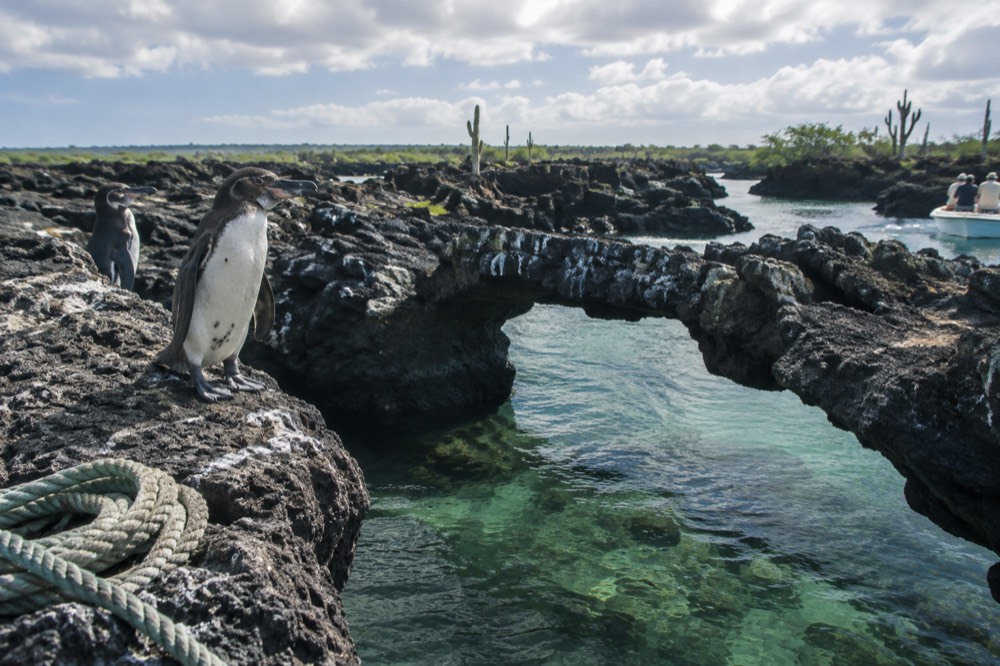
Seven nights also gives you slack. Day boats get cancelled for weather, particularly in the windy months of the cool season, and a five-night trip has no room to absorb that. With seven you rebook and lose nothing.
| Trip length | Suggested split | What you get |
|---|---|---|
| 5 nights | 5 on Santa Cruz | Highlands, one or two boat days, Tortuga Bay |
| 7 nights | 4 Santa Cruz, 3 Isabela | Adds Sierra Negra, Los Túneles, penguins, flamingos |
| 10 nights | 4 Santa Cruz, 3 Isabela, 3 San Cristóbal | Adds Kicker Rock, sea lion colonies, a full 360 boat day |
| 10 nights, alternative | 5 nights cruise, 5 nights land-based | Adds Genovesa, Fernandina or Española |
What you spend on the extra island you partly save back on excursions. Day tours from Isabela run $75 to $187 per person, against $145 to $245 from Santa Cruz, with Sierra Negra Volcano from around $77 and Los Túneles at the top of that local range at roughly $187. The ferry fare is real, but the tour prices on the far side soften it, and the fuller picture is in the Isabela day tour inventory.
There is also a way to taste Isabela without spending a ferry day on it, which suits anyone committed to the one-hotel five-night shape. The Day Tour to Isabela Island with Tintorera Islet, snorkeling in the wetlands and flamingos runs ten hours from Puerto Ayora, and the listing shows 4.7 from 138 reviews at from $285 per person, with snorkel gear, your choice of long or short wetsuit, lunch, soft drinks, the fuel surcharge and even the Puerto Ayora pier fee all included. You see the islet whose shallow channel gives it its name, the wetlands and the flamingo lagoons, and you sleep in your own bed on Santa Cruz that night.
Is Ten Days Too Long For The Galapagos?
No. Ten nights covers all three inhabited islands at a civilised pace and drops your cost per usable day sharply, since the park fee, transit card and flights are one-off charges spread across more days. It also opens the option of splitting the trip between a short cruise and a land base.
The fixed costs are the argument. Paying $200 and $20 and a $400 flight for three usable days is expensive per day. Paying the same for eight usable days is not. If time is available, longer is almost always better value here, which is the opposite of how most destinations work.
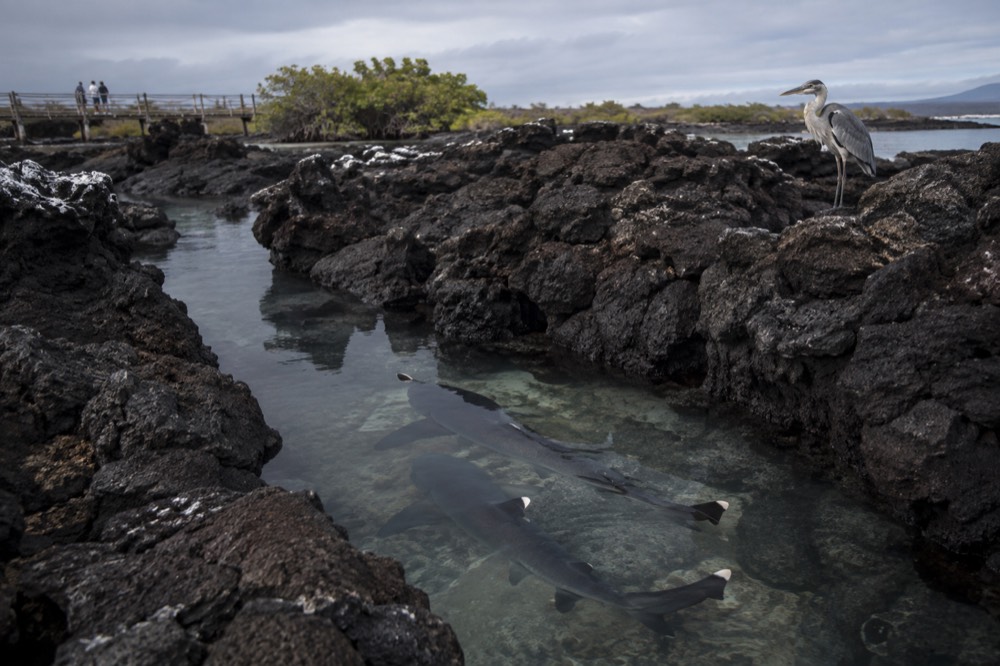
Where ten nights can go wrong is over-scheduling. Eight consecutive boat days is genuinely tiring, and there is a lot of sun, salt and early starts involved. Build in two unstructured days and use them for the free sites: Tortuga Bay, Concha de Perla, the Interpretation Centre. The Conservancy's planning notes make the same point about pacing. And if you are still deciding between formats, the cruise versus land-based comparison is the place to settle it before you count nights.
The mixed format is also where the cruise premium becomes visible on paper. Cruise berths typically run $450 to $1,000 or more per person per day, or $3,000 to $10,000-plus for a week-long package, while mid-range land-based trips average $250 to $350 per person per day with hotels, day tours and transport folded in. Splitting ten nights between the two gives you the far islands only a boat reaches, including the Darwin and Wolf area where whale shark season peaks June through November, followed by a cheaper, slower week with your feet on solid ground. Divers weighing that far-north segment should also read through the Galapagos diving hub before committing nights to it.
What Does A Week Of Day Tours Actually Cost?
A mid-range land-based week averages $250 to $350 per person per day once hotels, tours and transport are counted, and day tours themselves are priced by departure island: $145 to $245 from Santa Cruz, $75 to $187 from Isabela and $149 to $320 from San Cristobal. On top of that, fixed entry costs, flights, park fee and transit card, add roughly $470 to $820 per person before you sleep a single night.
The fixed slice comes first. Round-trip flights from Quito or Guayaquil typically cost $250 to $600 per person, the park fee is $200 for adults and $100 for children under 12, and the transit card is $20. Budget hotels in Puerto Ayora start around $30 to $65 per night, with mid-range rooms at $65 to $150, so a couple sharing halves the room cost per person. None of this shrinks because you stayed three nights instead of ten, which is the whole argument for length.
The variable slice, the tours, sorts cleanly by where the boat leaves from:
| Departure island | Typical day tour range | Example tours |
|---|---|---|
| Santa Cruz | $145 to $245 | North Seymour from $230, Bartolomé from $245 |
| Isabela | $75 to $187 | Sierra Negra Volcano from $77, Los Túneles from $187 |
| San Cristobal | $149 to $320 | Kicker Rock from $160, the 360° tour from $190 |
The listings we track sit inside those bands, mostly at the upper end. The Santa Fe Island and Hidden Beach day runs from $229 per person with a 4.9 rating from 91 reviews. The 7-Hour Pinzón, Snorkel and Fishing trip is from $249 with 4.9 from 154 reviews, the highest review count of any day boat we list, and it includes your choice of short or long wetsuit, lunch, drinks, towels and all fees. Pinzón carries a good conservation story too: black rats were eradicated from the island in 2012, which allowed tortoise hatchlings to survive naturally again, and more than 1,000 juvenile tortoises have since been repatriated there as part of the same restoration effort. The broader San Cristobal day tour range rounds out the picture if you are basing on the eastern island.
A worked example makes the totals concrete. Seven nights for one person, mid-range hotel at the midpoint of the range, two Santa Cruz boat days, one Isabela day, one highlands tour, one ferry crossing each way, plus flights and entry fees, lands somewhere in the low four figures before food. The same week on a cruise berth could easily cost double. Length is the cheapest upgrade available in the Galapagos.
Should The Season Change How Many Days You Book?
Yes, at the margins. The cool garúa season from June to November brings rougher seas, more weather cancellations and colder water, so short trips in those months need a buffer day they would not need between December and May. Wildlife calendars matter even more than weather if you have one specific must-see.
Sea temperatures tell the weather story. The warm season from December to May averages 74 to 76°F (23 to 24°C), while the cool season from June to November averages 66 to 72°F (19 to 22°C). Wetsuits, which several of the tours above include in the price, handle the cold without drama. The bigger issue is that windy cool-season mornings cancel boat departures, and a five-night trip has no spare day to rebook into, which is a strong argument for stretching to seven if your dates fall in that window.
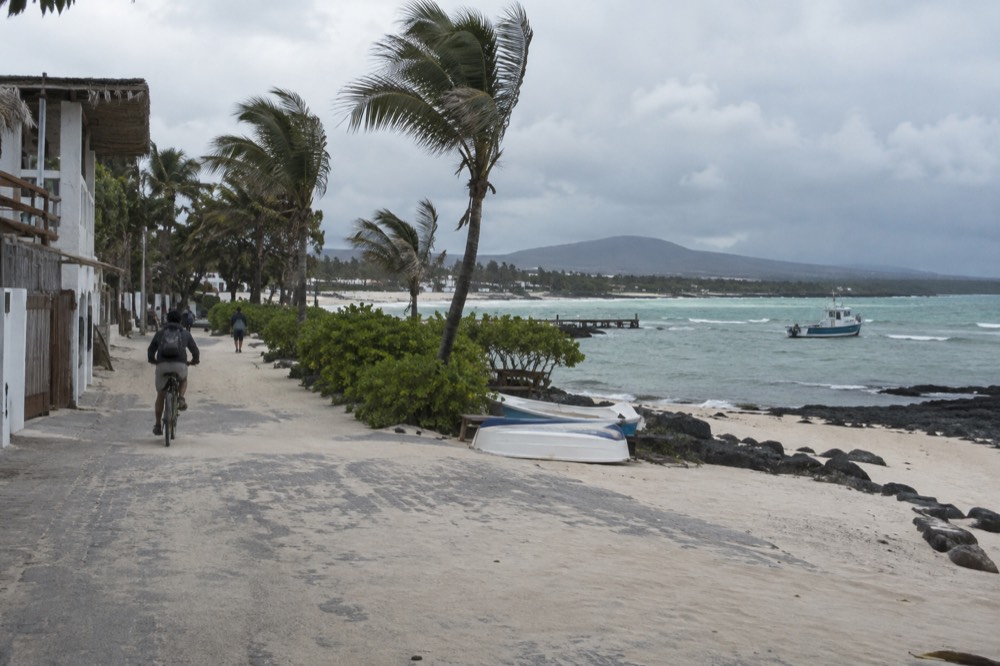
The wildlife calendar can also tilt the count in either direction. Blue-footed boobies court and mate between June and August; waved albatross are on Española breeding from April through December and absent only January to March; giant tortoise breeding peaks in the hot months of January to May, with nesting after and eggs hatching roughly 130 days later. Sea lion pupping peaks in August and September, which is when the snorkelling gets playful and the beaches get loud. If one of those is the reason for the trip, plan the length around the month rather than the reverse.
One exception cuts against every calendar: Galapagos penguins breed year-round with no clearly defined season, so a penguin-focused traveller can go whenever the flights are cheap and the boats are quiet. And the June to November whale shark season at Darwin and Wolf is irrelevant to day-tour planning anyway, because those islands sit well beyond day-boat range and are reached only on liveaboard itineraries.
Do You Need A Guide For Everything In The Galapagos?
Inside protected areas of the Galapagos National Park, yes: visitors must be accompanied by a naturalist guide authorized by the park directorate. The free sites named earlier in this guide, Tortuga Bay among them, involve no guide and no booking, which is exactly why they make good rest-day filler.
That rule is why nearly every experience on this page is a booked tour rather than a do-it-yourself trailhead. It is also why the unstructured days in a longer itinerary carry real value: they are the only days not metered by a guide's schedule or a boat's departure time. Budget them deliberately rather than treating them as wasted.
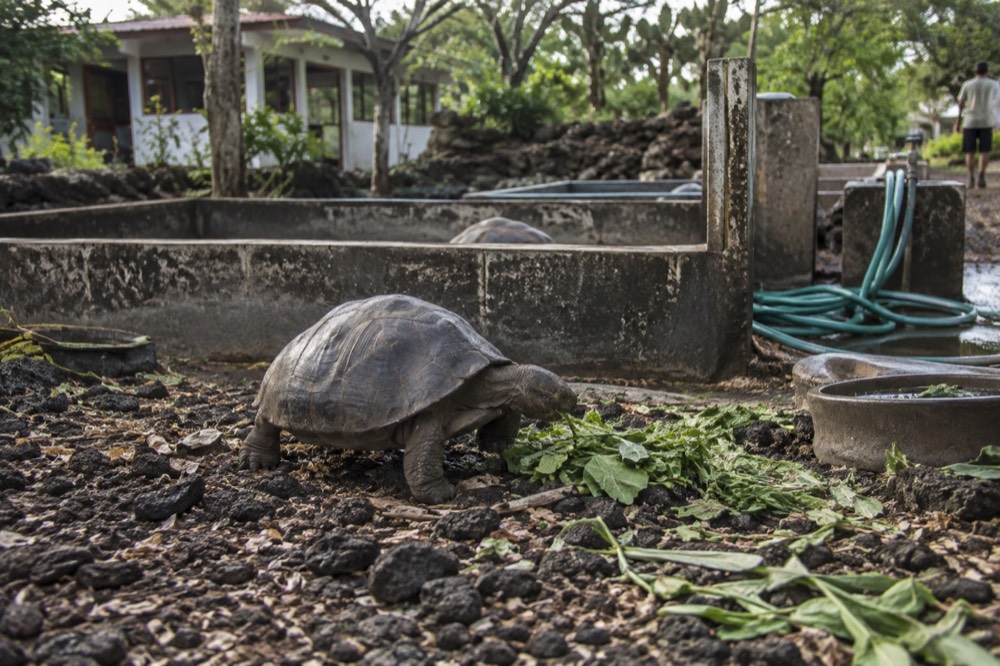
The park's other rules shape days in smaller ways. Keep at least six feet, two metres, from wildlife even when the animals approach you, and sea lion pups are the classic test of that rule because they will come to you. Drones are not permitted anywhere in the national park or the marine reserve, so the aerial camera stays home. And the biosecurity restrictions on fresh fruit, vegetables, seeds, plants and many animal products apply on entry, which is why the arrival-day inspection exists in the first place.
None of this costs time so much as it demands honesty about the schedule. Two guided activities in one day is workable when one of them is short, like the three-hour highlands tour, but pairing two ten-hour boat days back to back is how people end an eight-day trip needing a holiday from it.
What If You Do Not Want To Plan Any Of This Yourself?
Then a packaged island-hopping tour does the calendar for you: hotels, transfers, inter-island speedboats and guided day tours in one booking. You trade flexibility and some price transparency for the removal of every logistics decision this article has just walked through.
The format suits two kinds of traveller. First-timers who want the two-island classic without ever reading a ferry timetable, and anyone whose dates are locked in by school holidays or flights bought months ago. Everyone else usually comes out ahead booking the pieces separately, because you can match each day tour to your own stamina and drop the ones that do not appeal.
The package we track is the Galapagos 7-Day, 6-Night Island-Hopping Tour from Latina Real Tours Ecuador, departing from Puerto Baquerizo Moreno on San Cristobal. It rates 4.9 from 25 reviews, costs from $1650 with free cancellation on the listing, and includes six nights in double-room hotels with breakfast, all transfers, the public speedboats between islands, every tour mentioned with an English-speaking national park guide, and snorkeling equipment on the tours. Check availability
At the opposite end of the length spectrum sits the 3-Day Galapagos Trip for Traveler Without Much Time, run by GAGV and priced per group from $5600 rather than per person. It includes hotel, breakfast and lunch, a navigable tour with snorkeling, transfers, and a tour leader who doubles as the trip photographer, with free cancellation on the listing. It carries no reviews yet, so there is no traveller feedback to report, only the contents of the itinerary itself. Whether three days makes sense at that price is a question the day-count table above already answers.
Whichever way you book, the length rules in this guide still apply underneath the packaging. No operator can conjure a fifth excursion day out of five nights, and the companies selling three-day itineraries know their customers are buying convenience, not value per day. Where packages genuinely earn their margin is the shoulder stuff: no dock check-in anxiety, no rebooking scramble when a boat cancels, one phone number to call when something goes wrong mid-archipelago.
Can I visit the Galapagos as a day trip from mainland Ecuador?
No. Flights arrive mid-morning and leave the following morning at the earliest, and the $200 park fee plus $20 transit card apply regardless of length of stay. Three nights is the shortest trip that makes any financial sense, and even that is thin.
How many day tours should I book in a week?
Three or four across seven nights. More than that and the early starts stack up. Leave at least one day open for weather, tiredness or a beach you did not expect to love.
Should I book day tours before I arrive?
Book the marquee boat days ahead, especially in June to August and around the New Year, when popular boats sell out. Shorter highlands and bay tours can usually be arranged locally a day or two in advance.
Is it worth flying into one island and out of another?
Often, yes. Arriving at Baltra and departing from San Cristóbal removes one ferry crossing from a multi-island trip. Airlines price these open-jaw island routes reasonably, so check it before booking a return to the same airport.